Church Leadership·4 min read
Rick Warren Said It. Shepherd Systems Consulting Has the Tools to Build It.
Rick Warren wrote that for any renewal to last in a church there must be a structure to nurture and support it. Dr. Merrilyn Yeboah unpacks what that structure actually looks like and the tools that build it.
May 13, 2026 · Dr. Merrilyn Yeboah
If you have been in church leadership for any length of time, there is a good chance you have read Rick Warren's The Purpose Driven Church. It shaped how an entire generation of pastors thought about church health, ministry structure, and what a church is actually supposed to be doing.
I want to revisit something Warren said in that book. Not the five purposes. Most people know those. Something he said about what happens when a church has the right vision but the wrong infrastructure to carry it.
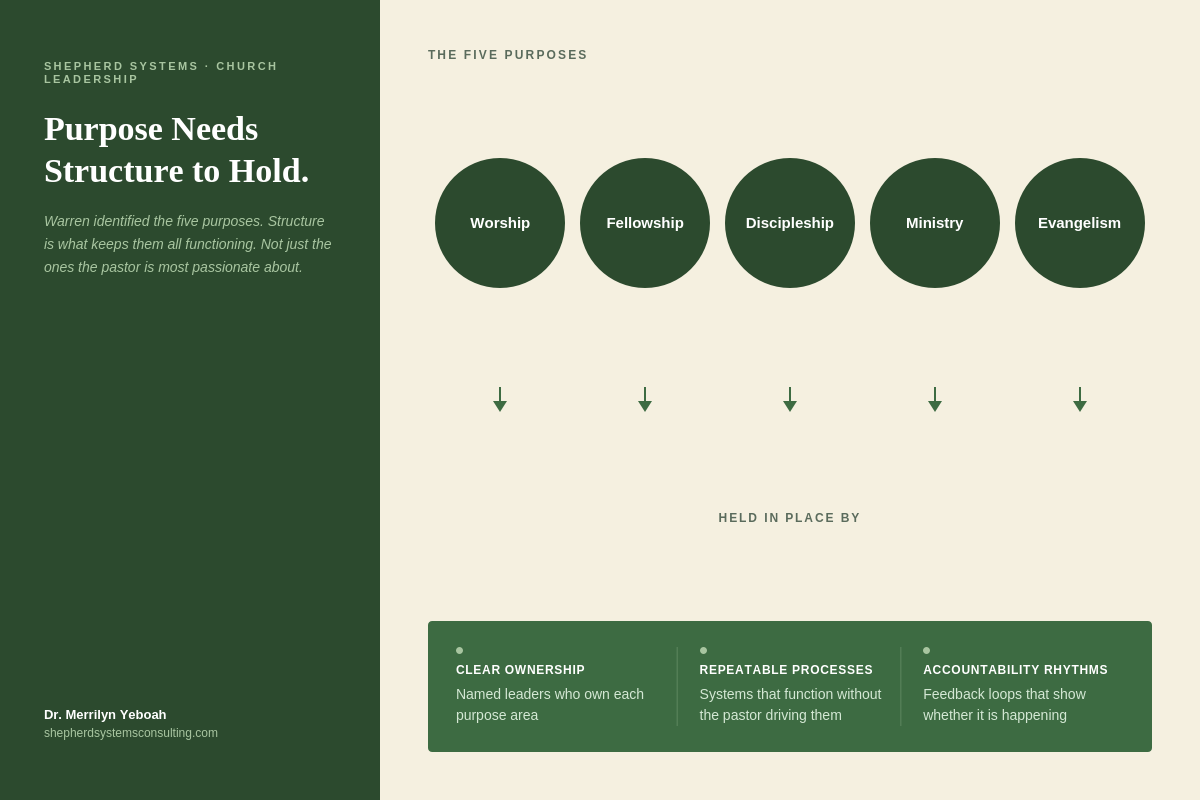
For any renewal to last in a church there must be a structure to nurture and support it. Unless you set up a system and a structure to intentionally balance the five purposes, your church will tend to over-emphasize the purpose that best expresses the gifts and passion of its pastor. Rick Warren, The Purpose Driven Church
Read that again. Warren is not talking about vision. He is not talking about preaching or prayer or spiritual gifts. He is talking about structure. He is saying that even a purpose-driven church, one with the right biblical foundation, will drift and become imbalanced without intentional systems in place to hold it together.
That is not a theological argument. That is an organizational behavior argument. And it is exactly what the field I was trained in has been saying for decades.
Vision without structure does not sustain. It drifts toward whatever the pastor cares about most and leaves everything else underdeveloped.
The gap Warren identified
Warren's insight was this. Without deliberate structure, a church defaults to the pastor's personality. If the pastor is an evangelist, the church reaches people well but struggles to retain them. If the pastor is a teacher, the church goes deep but rarely goes out. If the pastor is a shepherd, the congregation feels loved but the community barely knows the church exists.
This is not a character flaw. It is a structural reality. When there is no system balancing the church's purposes, the system that exists by default is the pastor's own giftedness and attention. One person, no matter how gifted, cannot hold all of it at once.
What Warren called for, intentional strategy and structure, is precisely what Organizational Behavior Management provides the tools to build. Not the vision. Not the theology. The operational framework that makes the vision sustainable.
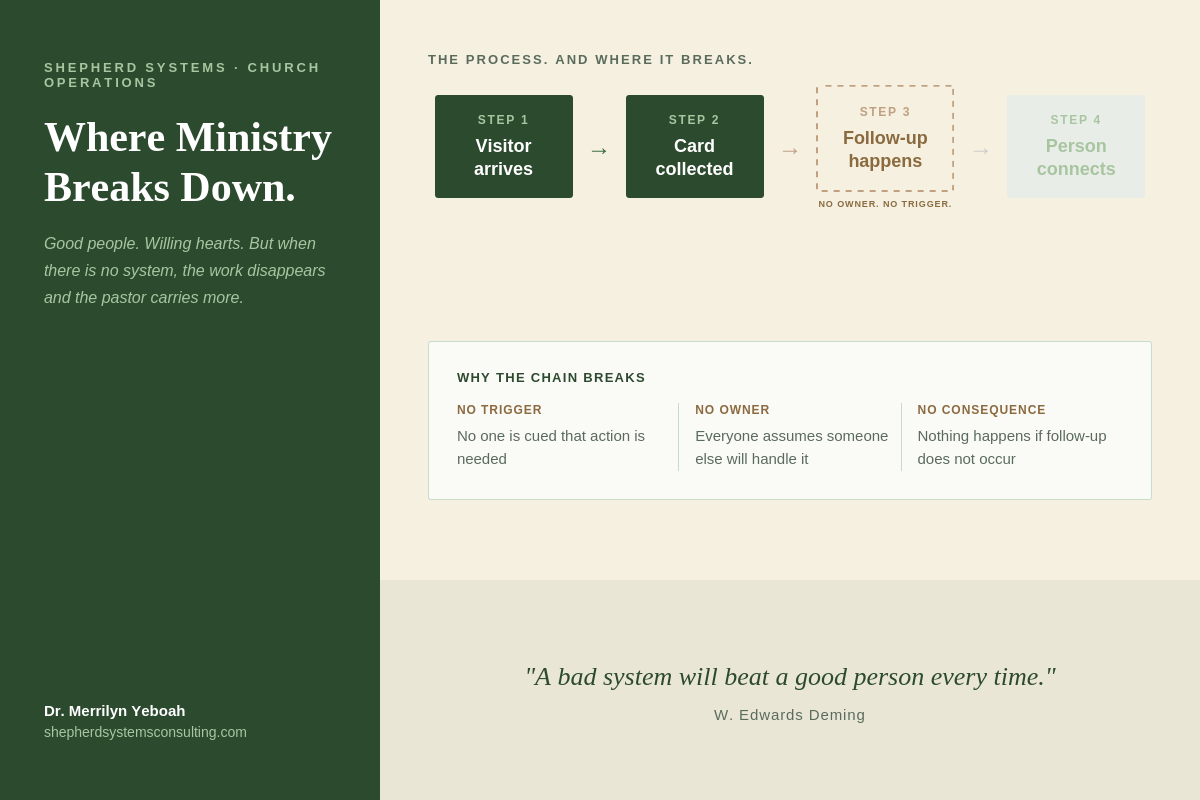
Think about what that actually requires. For a church to consistently carry out all five purposes, every one of those areas needs clear ownership, a defined process, and a way to know whether it is happening. Without those three things, the best you can hope for is that the right passionate person happens to show up and carry it. When they leave, it goes with them.
Purpose without process is a vision statement on a wall
I have walked into churches with beautiful mission statements. Framed on the lobby wall, printed in the bulletin, recited at membership classes. And then I ask a few operational questions. Who owns visitor follow-up specifically? What happens when a member goes quiet for three weeks? How does a new volunteer know what they are responsible for? The answers reveal that the vision lives on paper but not in structure.
That gap is not a spiritual problem. The people in those churches love God. They are committed. They want to fulfil the mission. Wanting to fulfil a mission and having the structure to consistently carry it out are two very different things.
Warren said it well. "If you will concentrate on building people, God will build the church." I believe that. And I would add: if you want to build people consistently, across every dimension of church life, you need systems that work even when the pastor is tired, unavailable, or simply human.
You can have the right purposes and still produce inconsistent results. The difference is almost always structure.
This is what I do
I want to demystify this a little. Some pastors hear the words "organizational behavior" and picture something cold and corporate. Spreadsheets, org charts, efficiency metrics. That is not what I am talking about.
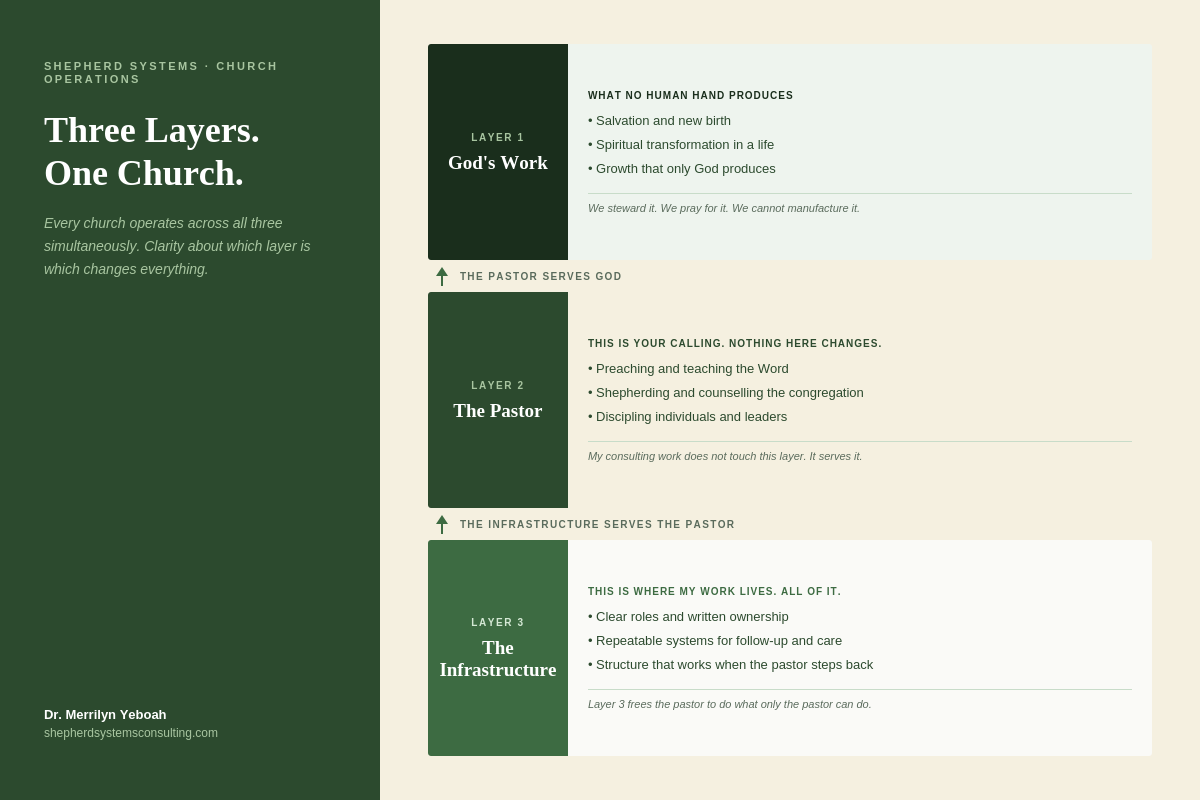
I am talking about building the kind of structure Warren described. Who specifically owns each ministry purpose in this church? What does consistent execution look like in each area? How does the church know whether it is actually happening, and what happens when it is not?
Those are practical questions, not theoretical ones. And the answers, the actual systems and structures that emerge from honestly working through them, are what allow a church to do what Warren envisioned. Grow warmer through fellowship, deeper through discipleship, stronger through worship, broader through ministry, and larger through evangelism. Consistently. Not just when everything is going well.
Warren also made a point that I have seen play out repeatedly. Many churches are personality-driven rather than purpose-driven, and that puts a congregation in a precarious position if the leader dies, moves, or has a moral failure. A church built on systems can survive leadership transitions. A church built on one person's capacity cannot.
A church built on purpose needs structure to hold that purpose in place. Otherwise the purpose follows the pastor and the congregation follows the purpose.
The work was always needed. Now there are tools for it.
Rick Warren was not writing about organizational behavior management. He was writing about church health. But what he identified, the need for intentional structure to sustain purpose, is exactly the problem that OBM was built to solve.
The tools exist. The framework is proven. And the church, which carries the most important mission on earth, deserves both.
That is what I came to do. Not to replace what God is building through pastors and congregations. To build the structure underneath it so the building holds.
If you are curious what that looks like for your church specifically, start with the free self-assessment on this site. It takes about ten minutes and will show you exactly where the structural gaps are. And if something resonates, I am easy to reach.
Shepherd Systems